
AI Optimization
Turn rising AI spend into measurable operating value.
FuseIQ shows where AI is being used, what it costs, where capacity is wasted, and which changes can improve performance without slowing adoption.
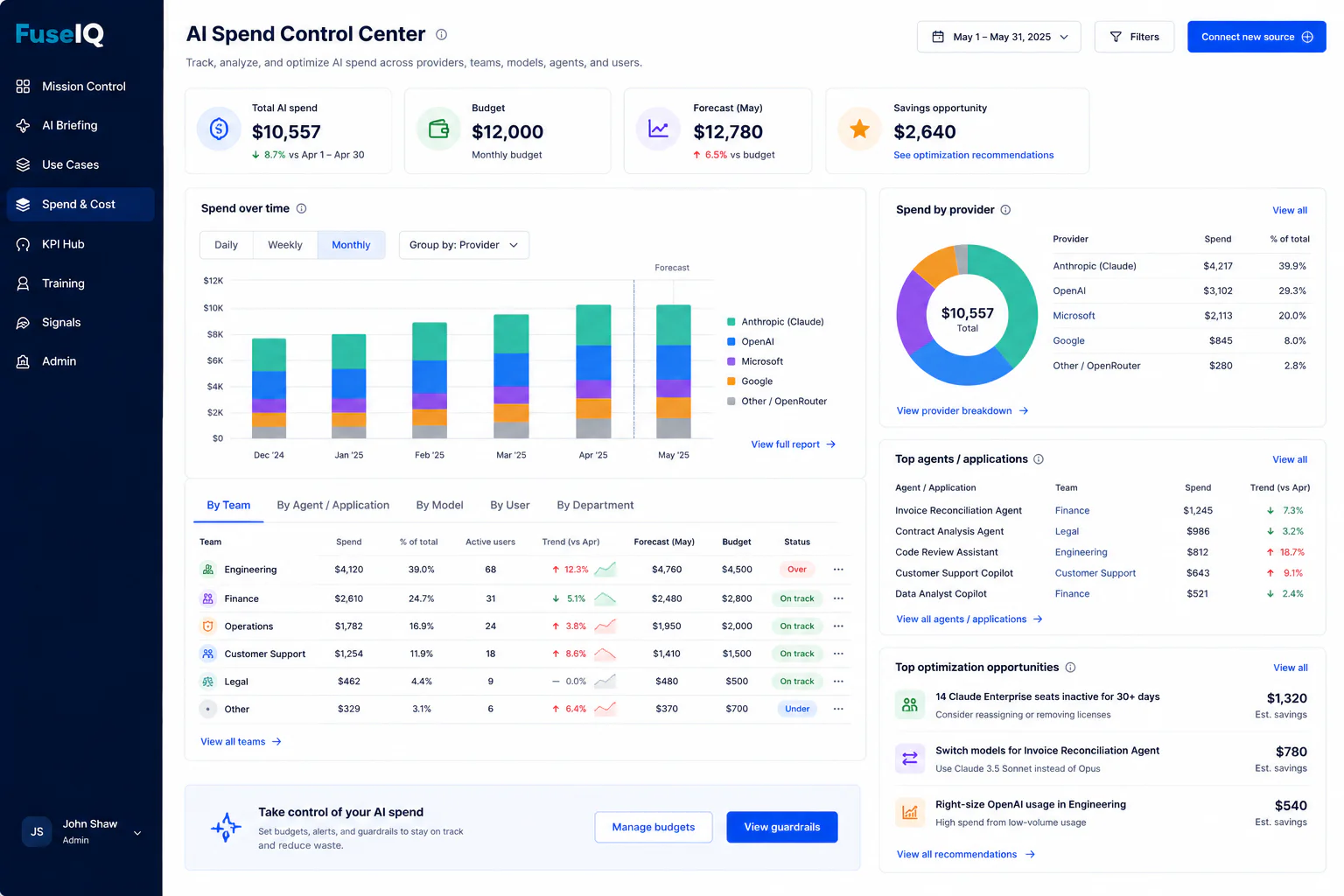
Spend grows faster than the visibility around it.
AI adoption spreads across providers, teams, and workflows before anyone owns a consolidated view of what is being consumed and what it returns.
- 01
AI costs are rising faster than visibility
Consumption grows across tools and teams while reporting stays behind the actual usage. - 02
Multiple providers create fragmented reporting
Each provider reports in its own structure, so there is no single, comparable view of the estate. - 03
License utilization is unclear
Seats are assigned without a reliable read on who is active and who is not. - 04
Cost cannot be compared where decisions are made
Teams cannot compare cost by model, workflow, agent, user, or transaction. - 05
Optimization decisions lack business-value context
Reducing spend without a value view risks cutting the work that is actually producing returns. - 06
Historical usage is incomplete or hard to analyze
Past consumption is scattered, retained inconsistently, and difficult to trend.
What the initial review includes.
The review is a working engagement run by PraxisIQ specialists with FuseIQ in place, producing a baseline and a ranked set of recommendations. It maps to the Understand and Optimize stages of the operating loop.
- AI provider and tool inventory
- A consolidated record of the AI providers, tools, and agents in use across the business.
- Usage and spend baseline
- A single baseline of consumption and cost to measure future change against.
- License-utilization review
- Assigned seats compared against observed activity by team and role.
- Model and workflow cost analysis
- Cost examined by model and by the workflows that consume it.
- Inactive or underused capacity
- Identification of capacity that is provisioned but not producing work.
- Initial KPI configuration
- The KPIs that will carry usage, cost, and value forward in FuseIQ.
- Prioritized optimization recommendations
- A ranked set of changes with owners, sequencing, and expected effect.
- FuseIQ access during the engagement
- Your team works in the platform alongside the review, not from a static deck.
- Executive findings session
- A leadership walkthrough of the baseline, the findings, and the decisions to make.
What FuseIQ makes visible.
The same views used during the review remain in place afterwards, so optimization stays an operating discipline rather than a one-time exercise.
- Usage and spend tracking
- Consumption and cost held together in one operating view.
- Budget monitoring
- Spend tracked against the budget owners have agreed to.
- Department and workflow reporting
- Reporting cut by the department and workflow consuming the capacity.
- Optimization recommendations
- Recommended changes surfaced as signals move, not only at review time.
- Adoption and value context
- Cost read alongside adoption and measured value so decisions stay balanced.
- Continuous performance improvement
- Each change is measured, and the result informs the next priority.
Examples of optimization opportunities.
These are the categories the review examines. What applies to your estate depends on what the baseline shows.
- Unused and duplicated licenses
- Seats assigned to people who are inactive, or overlapping tools covering the same work.
- Model selection by workload
- Workloads running on a heavier model than the task requires, or the reverse where quality suffers.
- Workflow and prompt efficiency
- Repeated calls, oversized context, and retries that consume capacity without improving output.
- Agent and job scheduling
- Automated runs firing more often than the business process needs.
- Provider and plan structure
- Consumption spread across plans and providers in a structure that no longer matches usage.
- Low-value initiatives
- Work that consumes capacity without an owner or a KPI attached to it in the portfolio.
What happens after the review.
The review ends with decisions, owners, and a live measurement view — not a report.
- 01
Decisions are made in the findings session
Leadership selects which recommendations to act on, in what order, and who owns each one. - 02
Changes are executed with governance in place
Each change carries an owner and an approval path so optimization does not slow adoption. - 03
Effect is measured against the baseline
The configured KPIs track what changed after the action, using the baseline established in the review. - 04
Optimization becomes continuous
Usage, spend, adoption, and value signals keep running in FuseIQ and feed the next round of priorities through the operating loop.
FuseIQ
Start an AI Optimization Review.
We will walk through the current AI estate, what a usage and spend baseline would cover, and the findings a review would put in front of your leadership team.